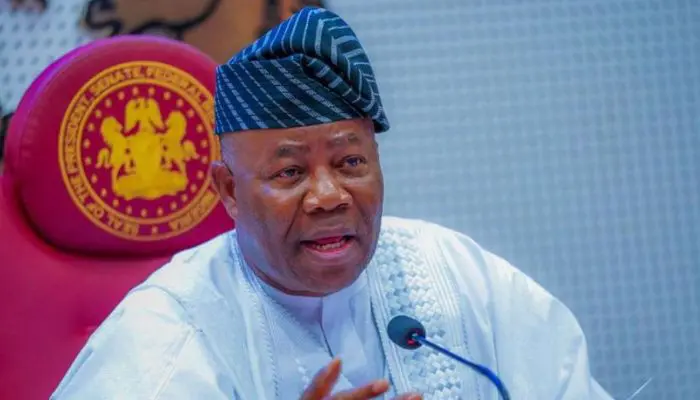
Senate President Godswill Akpabio has voiced strong support for President Bola Ahmed Tinubu as his administration reaches the three-year milestone, characterizing the government’s economic and infrastructure policies as essential moves for enduring national progress.
During a statement on Thursday celebrating Tinubu’s third year in office, Akpabio highlighted the President’s stewardship, contending that major policy moves and development projects under the Renewed Hope Agenda are starting to transform Nigeria’s economic landscape.
The Senate President referenced significant government initiatives such as the Lagos–Calabar Coastal Highway, the Nigerian Student Loan Scheme, the Renewed Hope Housing Programme, the introduction of CNG buses and conversion centers, tax reforms, and the finalization of the OB3 gas pipeline project as proof of the administration’s reform momentum.
According to Akpabio, even the most contentious decisions—like ending fuel subsidies and harmonizing foreign exchange rates—were tough yet essential actions aimed at building a more stable economic base.
He remarked that the boldness to tackle fuel subsidy removal, exchange rate unification, and infrastructure development despite global obstacles shows a leader dedicated to long-term prosperity rather than immediate gratification.
Akpabio also reiterated that the 10th National Assembly will continue to back the administration through legislation designed to maintain ongoing reforms.
Beyond praising the government’s accomplishments, the Senate President seemed to offer early political backing for Tinubu’s future electoral ambitions, expressing desire for the President to finish his term successfully and win upcoming elections.
This endorsement arrives amid ongoing discussions about the effects of the government’s economic policies. Supporters say the reforms are preparing the ground for future expansion, while detractors argue that increasing living costs and inflation have caused substantial suffering for many Nigerians.
Tinubu took office on May 29, 2023, and his administration’s economic reforms remain some of the most impactful and closely watched policy changes in Nigeria’s modern history.