Posted on Leave a comment

Inside the CLARITY Act Stalemate: Two Unrelated Battles Threaten Crypto Legislation

Inside the CLARITY Act Stalemate: Two Unrelated Battles Threaten Crypto Legislation

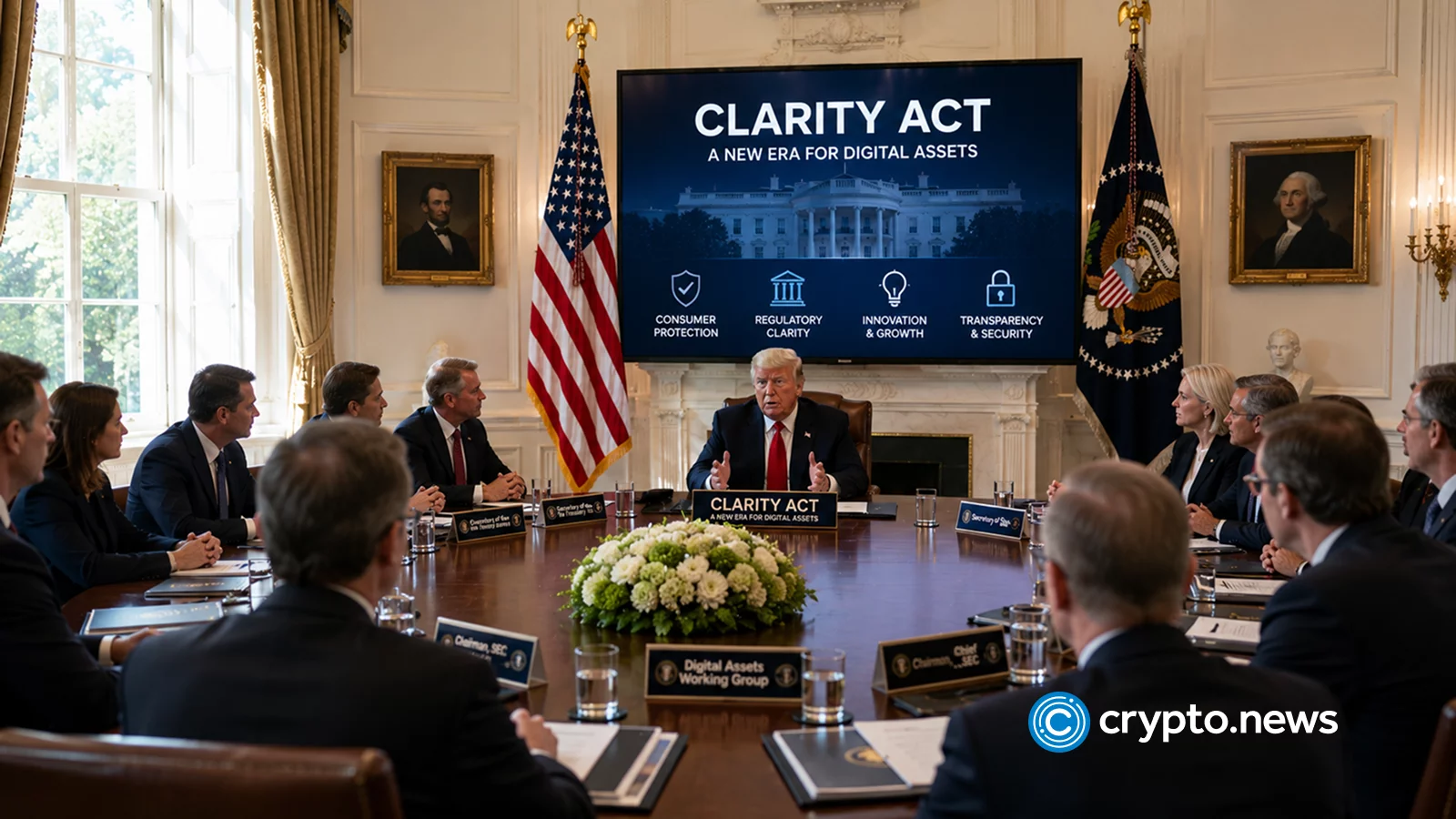
The CLARITY Act, once seen as nearly inevitable, now faces a double crisis. After clearing the Senate Banking Committee with a 15-9 vote on May 14, the bill appeared poised for passage, with prediction markets estimating a 74% chance of becoming law in 2026. However, by June, that probability dropped to around 48%, as two distinct and seemingly irreconcilable disputes emerged.

The first dispute centers on ethics. Democratic senators, including Ruben Gallego and Angela Alsobrooks, have made their support conditional on strong conflict-of-interest rules for government officials. This demand stems from President Trump’s family involvement in crypto ventures, reportedly generating $2.3 billion. The White House opposes any provision that appears to target the President personally, leading to a stalemate over enforcement mechanisms.

The second clash involves Section 604, which protects software developers from being classified as money transmitters. Law enforcement groups argue this creates a loophole for criminals, citing $158 billion in illicit crypto volume in 2025. Senators Mark Warner and Catherine Cortez Masto have tied their votes to resolving this issue, creating a separate veto bloc.

These two fights are deeply problematic because they cannot be resolved through simple compromises. Satisfying the ethics demands does nothing to appease law enforcement, and vice versa. The bill needs approximately seven Democratic votes beyond the two committee crossovers to filibuster-proof sixty votes, but four of the most likely supporters are currently locked in opposing camps.

Section 604 itself is a flashpoint. It was already weakened to secure the committee vote, angering DeFi advocates. Now, law enforcement wants it further reduced, while developers demand its restoration. Any adjustment risks alienating one side. This internal tension makes the bill vulnerable to time running out; with only 31 Senate session days before the August recess, unresolved disputes could delay the legislation for years.

The calendar is perhaps the biggest threat. If the bill does not pass in this window, it may not be revived until after the next congressional election, leaving crypto regulation fragmented. The failure would not be due to widespread opposition but to the inability to align two unrelated fights, a frustrating outcome for supporters who see the bill as essential for clarifying market structure.

As negotiations continue, key indicators include whether Democratic holdouts like Gallego and Alsobrooks signal flexibility, and whether law enforcement groups are satisfied by White House efforts. The prediction markets will likely react quickly to any resolution, but for now, the CLARITY Act remains trapped in its own machinery.


Posted on Leave a comment

MicroStrategy Acquires Additional $100M in Bitcoin, Boosting Reserves to 846,842 BTC

MicroStrategy Acquires Additional $100M in Bitcoin, Boosting Reserves to 846,842 BTC

Michael Saylor’s firm, now known as Strategy, has once again expanded its Bitcoin holdings, purchasing 1,587 BTC for roughly $100 million. This latest move brings the company’s total Bitcoin reserve to 846,842 coins, valued at approximately $56 billion given current market prices around the mid-$60,000 range.

Earlier this month, Strategy faced scrutiny after selling a small portion of its holdings—32 BTC—for about $2.5 million. Company CEO Phong Le clarified that the sale was merely a test of internal processes, not a shift in strategy or a need for cash. The recent acquisition reaffirms the company’s commitment to its Bitcoin-first approach.

In addition to expanding its cryptocurrency portfolio, Strategy has also bolstered its U.S. dollar reserve. The firm now holds $1.1 billion in cash, up $100 million from the previous week. This dual increase in both Bitcoin and cash reserves suggests the company is balancing its accumulation strategy while ensuring it can meet financial obligations like dividends.

Investors and market watchers have taken note of the company’s continued buying, which helps dispel concerns raised by the earlier small sale. Strategy remains the largest corporate holder of Bitcoin, and its ongoing purchases signal confidence in the digital asset’s long-term value.

Posted on Leave a comment

Bitcoin Whales Accumulate Amid Peter Brandt’s Bearish Chart Warning

Bitcoin Whales Accumulate Amid Peter Brandt's Bearish Chart Warning

Veteran trader Peter Brandt recently highlighted that Bitcoin continues to offer one of the clearest examples of classical chart analysis among all markets. In a post on social media, Brandt noted that few other assets adhere as neatly to traditional charting principles as Bitcoin does. His weekly chart, spanning from 2023 to 2026, reveals multiple channels, wedges, and consolidation zones. The current structure appears weaker, with Bitcoin hovering near $65,261, well below the 18-week moving average of around $71,253. The chart also indicates a breakdown from a rising channel established earlier in 2026. The ADX indicator, reading near 28.27, suggests a moderately strong trend, but the break below both the channel and moving average points to growing downside momentum.

Meanwhile, data from CryptoQuant tells a more optimistic story. The firm reported a significant drop in Bitcoin Inflow Coin Days Destroyed, from 2.16 million to roughly 33,000, indicating that older coins are no longer moving to exchanges at the previous pace. The earlier sell-off in early June saw Bitcoin fall from about $71,300 to $63,800 as long-term holders reduced exposure. However, the latest data reveals renewed whale accumulation, with over 11,400 BTC—worth about $700 million—moving from exchanges to private wallets in recent days. This suggests that selling pressure from large holders is easing.

Bitcoin managed to climb above $65,500 on Monday following a peace deal between the US and Iran, which alleviated oil and inflation concerns. At the time of reporting, Bitcoin was trading above $66,000, marking a 3% increase in 24 hours, with a daily high near $65,893. The rebound pushed Bitcoin back toward the upper boundary of the $60,000 to $65,000 support zone. The next key resistance level is around $68,000, where sellers may attempt to halt the recovery. Technical indicators remain mixed, as a sustainable move above $68,000 requires stronger volume to confirm demand. ETF outflows and broader market caution also continue to influence sentiment.

These two contrasting signals create a complex outlook. Brandt’s chart analysis suggests Bitcoin could remain under pressure while it trades below the 18-week moving average and within a weak weekly structure. His view does not dismiss a potential long-term recovery but emphasizes the need for patience before a confirmed breakout. On the other hand, CryptoQuant’s whale data offers a more supportive perspective. If large holders persist in withdrawing Bitcoin from exchanges, selling pressure may continue to diminish. The next significant move for Bitcoin hinges on whether buyers can transform whale accumulation into a decisive break above resistance. If not, attention may shift back to last week’s lows near the $60,000 area.

Posted on Leave a comment

BitMine Boosts ETH Holdings to 5.62 Million as BMNR Stock Flattens

BitMine Boosts ETH Holdings to 5.62 Million as BMNR Stock Flattens

BitMine Immersion Technologies has expanded its Ethereum position again, now holding 5,620,754 tokens as of mid-June. This brings the company closer to its ambitious goal of owning 5% of all Ethereum in circulation. The firm’s latest disclosure reveals that this stash equals 4.66% of the total ETH supply, which stands at roughly 120.7 million coins.

Alongside its massive Ethereum treasury, BitMine reported a combined portfolio of digital assets, cash, and strategic investments valued at $10.4 billion. This includes 204 Bitcoin, $502 million in cash and marketable securities, plus stakes in Beast Industries and Eightco Holdings worth $180 million and $88 million respectively. Chairman Tom Lee noted that the company added 76,881 ETH over the past week, maintaining an aggressive buying pace because they believe the recent price drop doesn’t reflect Ethereum’s improving fundamentals.

BitMine’s staking operations now involve 4,718,677 ETH, worth around $8.1 billion at current prices. This generates projected annual rewards of about $219 million, providing a steady cash flow to support dividends on the company’s preferred stock. The firm recently closed the sale of 3.5 million shares of Series A perpetual preferred stock, netting roughly $273.8 million after expenses. Lee described this move as balance sheet diversification, with staking income expected to cover dividend payments.

Despite these developments, BMNR shares showed little change, trading near $16.11 with a market cap of about $7.32 billion. The stock’s muted reaction comes after weeks of intense focus on BitMine’s Ethereum treasury strategy. The company noted that BMNR remains one of the most actively traded U.S. equities, with average daily dollar volume of $550 million over the past five sessions. Investors now watch to see if BitMine can continue growing its ETH per share while meeting weekly dividend obligations.

Posted on Leave a comment

World Cup Fuels XRP Adoption: XRPPower Enables $4,770 Daily Earnings

World Cup Fuels XRP Adoption: XRPPower Enables $4,770 Daily Earnings

The upcoming 2026 FIFA World Cup is placing cross-border digital payments in the spotlight, and XRP is emerging as a key player in this space. As global attention turns to efficient payment solutions, XRP’s practical utility is gaining traction among institutions and individuals. Beyond the hype of price swings, users are increasingly looking for ways to participate in the digital economy that do not solely depend on market volatility. They seek steady, long-term value through smarter systems.

In response, XRPPower has introduced an AI-driven XRP/BTC Smart Participation Model. This system leverages artificial intelligence to enhance the digital asset experience, offering XRP holders a pathway to passive income in the evolving financial landscape. The platform emphasizes transparency through on-chain data verification, enabling users to query and trace key information. This builds trust and accountability.

XRPPower also references international audit standards, engaging professional firms like PwC to refine risk management and operational processes. Security is fortified with enterprise-grade measures including SSL/TLS encryption, DDoS protection, and real-time threat monitoring. AI-powered risk control automatically detects anomalies and mitigates potential issues, ensuring a reliable environment for users worldwide.

To get started with XRPPower, users first register an account via email. Then, they select a suitable XRP/BTC smart contract plan based on their financial goals and desired participation period. After activation, the system connects to the AI infrastructure, allowing users to monitor account performance, earnings, and asset status through a personal dashboard. This provides a convenient way to manage digital participation.

Example contracts illustrate potential returns: a $5,000 investment over 15 days yields $70.50 daily, for a total of $1,057.50 plus principal refund. A $10,000 plan over 20 days earns $153 per day, totaling $3,060 with principal returned. These options illustrate flexible engagement levels for different preferences.

XRPPower describes itself as a platform focused on AI, digital ecosystems, and smart technology services. With a presence in 189 countries and over 3 million users, it aims to drive digital innovation through secure, transparent, and compliant operations. The platform combines AI systems with global reach to deliver a safer and smarter digital experience.

Posted on Leave a comment

Bitcoin Downturn Risks Restructuring for Treasury Firms, Warns Strive CIO

Bitcoin Downturn Risks Restructuring for Treasury Firms, Warns Strive CIO

Ben Werkman, Chief Investment Officer at Strive, cautioned at BTC Prague that a prolonged slump in Bitcoin prices could force treasury-focused companies to reconsider their financial strategies. Firms that accumulated Bitcoin using convertible debt may face heightened pressure if the cryptocurrency remains well below its peak near $126,000.

Werkman noted that while rising Bitcoin values would alleviate many issues, an extended downturn could compel some companies to sell their Bitcoin holdings to cover operating costs or service debt. This is especially true for firms with financing agreements tied to collateral or coverage requirements. He highlighted that Strive avoided convertible bonds entirely, relying instead on equity financing, which has allowed the firm to continue expanding without similar strain.

Consolidation in the sector is a likely outcome if market weakness persists, according to Werkman. He pointed to Strive’s acquisition of Semler Scientific as an example of how mergers could help financially constrained firms. However, he acknowledged that company leaders are often hesitant to sell at reduced valuations, which has limited such deals so far. The Semler transaction succeeded because its Chairman supported Strive’s preferred-stock model, even though it lacked sufficient shareholder backing at Semler itself.

Other firms are already adjusting their balance sheets. Werkman mentioned Nakamoto’s efforts to reduce debt and restore operational flexibility, describing these moves as attempts to escape financing constraints built up during more favorable market conditions.

Recent events at Strategy have fueled debate about the balance between Bitcoin accumulation and shareholder obligations. The firm sold 32 BTC earlier this month, raising around $2.5 million at an average price of $77,135. While some interpreted this as a shift in strategy, Strategy CEO Phong Le clarified that it was a test of internal systems, not a cash-raising move. He emphasized that the company still has access to equity and preferred stock funding.

Werkman defended the sale, arguing that it demonstrated Bitcoin’s liquidity to credit markets and rating agencies. He noted that rating agencies currently assign Strategy a credit rating that effectively treats its Bitcoin holdings as worthless. Proving the ability to convert Bitcoin into cash is therefore crucial for firms with dividend obligations. He stressed that companies cannot build balance sheets around a single asset while refusing to ever use it; occasional sales help show Bitcoin’s resilience as a treasury asset.

Despite the sale, Strategy continued accumulating. On June 15, Michael Saylor announced the purchase of 1,587 BTC for $100 million, bringing total holdings to 846,842 BTC, with dollar reserves at $1.1 billion. This follows a purchase of 1,550 BTC earlier in June, showing the firm’s ongoing commitment to its accumulation strategy while also boosting liquidity.

Posted on Leave a comment

Paradigm Backs El Dorado’s $9M Round for LatAm Stablecoin Payments

Paradigm Backs El Dorado's $9M Round for LatAm Stablecoin Payments

Paradigm has spearheaded a $9 million Series A investment round for El Dorado, a Latin American payment platform that leverages stablecoins to facilitate cross-border transactions. The funding, announced on June 15, also saw participation from Coinbase Ventures and Verda Ventures, according to a statement from Paradigm.

Ricardo de Arruda, a partner at Paradigm, highlighted that Latin America handles over $100 billion in annual cross-border payment flows, yet the region relies on outdated, costly, and opaque systems. He noted that El Dorado is building the essential payment infrastructure to address this gap.

Founded in 2022 by immigrants from Latin America, El Dorado now boasts over 100,000 active users and has processed more than 5 million transactions. The company operates across 12 countries, including Argentina, Bolivia, Brazil, Colombia, Costa Rica, the Dominican Republic, and Ecuador.

Guillermo Goncalvez, co-founder and CEO of El Dorado, offered a broader perspective, stating that the region’s annual cross-border payment activity may reach nearly $1 trillion when including wider flows. He emphasized that about 60% of these transactions are business-to-business payments, primarily for imports and exports between the U.S. and Latin America. Goncalvez pointed out that many lucrative payment corridors, such as the route connecting Brazil and Bolivia, are overlooked by larger fintech firms like Nubank and Wise.

In addition to consumer services, El Dorado has launched a dedicated business platform that integrates fiat and stablecoin payment rails within a single app. The platform supports multi-signature and multi-organization account structures. More than 100 corporate clients have already joined, with electric vehicle imports from China emerging as a prominent use case.

El Dorado’s infrastructure is built on Tempo, a Layer 1 blockchain developed through a collaboration between Paradigm and Stripe. Josh Itzkovitz from Tempo explained that the network enables businesses worldwide to create accounts without needing a U.S. legal entity.

This investment is part of Paradigm’s broader push beyond traditional crypto venture capital. The firm has recently supported SendCutSend with a $110 million round, partnered with Stripe on the Tempo blockchain, and engaged in policy advocacy for stablecoin regulations. Earlier this month, Paradigm submitted comments to the FDIC opposing restrictions on third-party stablecoin reward programs, arguing such limits exceed the authority granted by the GENIUS Act. These initiatives underscore Paradigm’s focus on stablecoin-based payment solutions.

Posted on Leave a comment

Kraken Brings Perpetual Futures to US via CFTC-Regulated Platform

Kraken Brings Perpetual Futures to US via CFTC-Regulated Platform

Kraken has rolled out perpetual futures for eligible American clients through its CFTC-compliant derivatives arm, marking a significant expansion of its US offerings. The product, which generated over $60 trillion in global crypto trading volume in 2025, is now accessible on Kraken Pro alongside spot, margin, and traditional futures.

The exchange announced on June 15 that qualified US traders can use a single Kraken Pro account to manage multiple trading strategies without switching platforms. Perpetual futures, which never expire and allow indefinite position holding, have become the dominant crypto derivative due to continuous trading and funding rate mechanisms that keep prices aligned with underlying assets.

Kraken leveraged its acquisition of Bitnomial, a CFTC-licensed derivatives platform, to offer this service. Bitnomial holds exchange, clearinghouse, and brokerage licenses, enabling Kraken to operate within US regulatory frameworks. Traders can now use a unified collateral pool for perpetual futures and other derivatives, eliminating the need to move assets between separate venues.

Arjun Sethi, co-CEO of Payward and Kraken, emphasized that consolidating spot, margin, futures, and perpetual contracts into one account simplifies capital management and reduces operational friction. John Palmer, Kraken’s global head of derivatives, noted that previously traders had to manage perpetuals and other positions on different platforms, but now they can access everything through a single counterparty.

This launch follows a similar move by Coinbase, which received approval to offer global crypto perpetual futures to US users just days earlier. Coinbase’s CEO Brian Armstrong stated that the approval would connect American traders to offshore liquidity via Deribit, a derivatives exchange acquired for $2.9 billion. Both developments reflect a shift in US regulatory attitudes, as authorities begin permitting access to products historically concentrated on overseas platforms under compliance requirements.

Posted on Leave a comment

Ranking Gated Content: 7 SEO Tactics for Membership Sites in 2026

Ranking Gated Content: 7 SEO Tactics for Membership Sites in 2026

Running a membership site on WordPress often comes with a frustrating issue: your best content is hidden behind a login or paywall, making it invisible to Google. While this protects your revenue, it can hinder search visibility. However, you don’t have to sacrifice SEO for content security. With the right approach, you can help Google index your teaser content, keep premium material safe, and drive more organic traffic to your site. This guide outlines seven strategies to achieve that balance.

The core challenge is that Google can only index publicly accessible content. Your protected pages—like member dashboards and locked lessons—won’t appear in search results. The solution is a teaser-wall approach: show a preview of your content to both users and search engines, while keeping the full version for members. This is not cloaking, which violates Google’s guidelines; it’s a legitimate way to provide value without deception.

Strategy 1: Leverage Teaser Content Create a public preview of your gated pages, such as the introduction or key takeaways. Include your primary keyword in this visible section, use relevant headings, and aim for at least 200-300 words. MemberPress makes this easy by allowing you to set content excerpts. This approach not only helps SEO but can also boost conversions by showing potential members the value of your premium content.

Strategy 2: Implement Content Dripping Carefully Dripping content—releasing lessons or modules over time—doesn’t harm SEO, but unreleased content won’t be indexed. To mitigate this, create teaser pages for upcoming material. Even a brief summary can help search engines understand the topic and prepare for future indexing.

Strategy 3: Publish Valuable Free Content Don’t gate everything. Free articles, tutorials, and guides attract search traffic, earn backlinks, and build trust. Target broad informational keywords with free content, and reserve advanced training, templates, and proprietary resources for members. This creates a funnel where free content introduces your expertise, and premium content encourages upgrades.

Strategy 4: Strengthen Technical SEO Ensure your site has HTTPS, fast loading speeds, mobile-friendly design, and no broken links. Use plugins like All in One SEO to generate XML sitemaps and manage technical settings. A solid technical foundation helps search engines crawl and index your content efficiently.

Strategy 5: Noindex Low-Value Pages Pages like login, account, checkout, and thank-you pages serve members but offer little search value. Preventing them from being indexed helps Google focus on your high-value content, such as blog posts and teaser pages. Use AIOSEO to easily set noindex directives on these pages.

Strategy 6: Use Internal Links to Connect Free and Paid Content Internal links guide visitors from your free content to your membership offers. For example, link from a blog post to a premium course page using descriptive anchor text like “Get the full training in our membership program.” This helps search engines understand site structure and drives conversions.

Strategy 7: Optimize for Conversions Traffic alone doesn’t grow your membership business. Use tools like OptinMonster to convert visitors into members. Exit-intent popups can offer free trials or discounts, inline content upgrades promote relevant resources, and scroll-based slide-ins appear after engagement. A typical funnel is: SEO traffic → free content → teaser preview → OptinMonster campaign → membership signup.

Measure Your Success Track metrics like organic traffic, keyword rankings, and most importantly, membership signups and conversion rates. Use MonsterInsights to see which pages drive the most traffic and conversions. Regularly reviewing these reports helps you refine your strategy.

Frequently Asked Questions Google does not penalize properly implemented gated content. It cannot index content behind a login, so teaser content is essential. AI tools also cannot access gated material, but they can cite your public teasers. Noindex login and account pages. Gated content requires an action (like signing up), while paywalled content requires payment. Aim for 200-300 words of teaser content. Content dripping does not hurt SEO, but unreleased content won’t rank. Backlinks matter; focus on earning them for your free content and use internal links to promote memberships.

Posted on Leave a comment

Mayorkun’s Mom Thought Davido Was a Scammer at First

Mayorkun's Mom Thought Davido Was a Scammer at First

Actress Toyin Adewale, the mother of Nigerian singer Mayorkun, recently revealed her initial skepticism when superstar Davido first reached out to her son. Speaking on the Talk to B podcast, she admitted that the family believed Davido’s direct message to Mayorkun was a scam attempt.

According to Adewale, Mayorkun had just gone viral with a cover song when Davido slid into his DMs. She recounted, ‘After that cover, he was with his brother when the message came in. We were certain it was a scammer.’ However, Davido later called Mayorkun directly, and the singer’s excitement was palpable. ‘He was almost losing his mind,’ she added.

Davido instructed Mayorkun to send his measurements, as he was traveling. Upon his return, Mayorkun and his brother went to meet the ‘FEM’ crooner. ‘Davido handed them a full box of gifts and money. I was nervous because I didn’t really know him then,’ Adewale shared.

Their meeting led to the recording of the hit track ‘Eleko’ the very next day. Mayorkun’s background in church choir and poetry made the transition smooth. He eventually moved in with Davido, and when Adewale visited, she found Davido to be ‘very pleasant and respectful.’

This story highlights the pivotal role Davido played in launching Mayorkun’s career, a journey that began with a simple but doubted message.