Posted on Leave a comment

Groq Secures $650M for Neocloud Venture After Landmark Nvidia Deal

Groq Secures $650M for Neocloud Venture After Landmark Nvidia Deal

Groq is in the process of securing up to $650 million from its current investors to launch a new entity called Groq2. This move comes shortly after the company finalized a massive $20 billion licensing and asset agreement with Nvidia, which has fundamentally reshaped its direction. The funding will be used to construct AI-focused neoclouds, marking a strategic shift away from chip manufacturing toward providing AI infrastructure services.

The capital is being raised from existing backers including Disruptive and Infinitum, who are prepared to cover the entire amount if needed, with other current shareholders given the opportunity to participate on a pro rata basis. This initiative follows Nvidia’s largest-ever transaction, a roughly $20 billion cash deal for Groq’s AI inference technology, structured as a non-exclusive license combined with an asset sale. As part of that agreement, Nvidia acquired Groq’s inference stack and hired many of its key leaders, including founder and CEO Jonathan Ross and president Sunny Madra.

Despite the significant transfer of technology and talent, Groq retained ownership of its cloud business and intellectual property. The company’s statement emphasized that GroqCloud was not part of the transaction and would continue to operate without interruption. This carve-out forms the foundation of the Groq2 strategy, which will pivot entirely from chip design to building neoclouds optimized for real-time AI workloads. According to Axios, the new entity will compete directly with hyperscalers and other AI hosting providers that rely on Nvidia hardware rather than developing their own silicon.

For Nvidia, the deal reinforces its dominance in AI inference and data center acceleration, following its $57 billion quarterly revenue in 2025. For Groq2, the $650 million raise is a high-stakes bet that its neocloud model can attract sufficient demand to thrive as a standalone platform. However, Disruptive CEO Alex Davis has cautioned that a build-it-and-they-will-come approach could lead to a financing crisis for speculative AI data center operators by 2027 or 2028, highlighting the risks Groq2 faces in a market dominated by established players.

Posted on Leave a comment

YC Creator Program: Bridging Web3 Storytellers and AI Innovators

YC Creator Program: Bridging Web3 Storytellers and AI Innovators

YZi Labs, the venture arm formerly known as Binance Labs, has unveiled a curated Creator Program designed to connect storytellers specializing in Web3, artificial intelligence, and frontier technologies directly with over 300 portfolio companies. This initiative provides creators with exclusive access to founders and distribution channels, while portfolio projects gain skilled narrative specialists to articulate their vision across various media. The program transforms YZi’s extensive deal flow into a structured pipeline, offering creators warm introductions to early-stage teams and helping startups avoid wasteful marketing spend on generic agencies. By formalizing this network, YZi aims to integrate narrative, hiring, and capital into a cohesive ecosystem. The move aligns with YZi’s broader strategy, which includes the EASY Residency incubation track for early-stage founders and the recent YZi Talent recruitment platform that aggregates job openings from its portfolio. Additionally, the $1 billion Builder Fund supports early-stage founders on BNB Chain with up to $500,000 per team. This creator program comes as Web3 platforms increasingly emphasize direct monetization for creators, and YZi’s approach seeks to ensure that stories about the next wave of innovation are told by specialists embedded within its portfolio, rather than by external influencers. With Bitcoin trading above $70,000 and Ethereum above $2,000, the market backdrop reinforces the capital flowing into crypto and AI ventures, and YZi is betting that these flows will be intermediated by a tightly controlled narrative machine built inside its own network.

Posted on Leave a comment

Trezor Adds USDC and USDT Yield via Morpho Vaults

Trezor Adds USDC and USDT Yield via Morpho Vaults

Trezor has introduced a new feature within Trezor Suite that allows users to earn returns on their USDC and USDT holdings. This is made possible through a partnership with Morpho, a decentralized lending protocol. The integration enables users to deposit stablecoins into curated vaults managed by Steakhouse Financial, which then lend out these assets to borrowers, generating yield from interest payments rather than token incentives.

By keeping the entire process within the Trezor ecosystem, users maintain full control of their private keys. All transactions, including deposits, withdrawals, and reward claims, are signed directly on the hardware wallet using clear-signing technology, which displays transaction details in a human-readable format on the device screen. This setup ensures that funds remain in self-custody while being deployed on-chain.

The two vaults available at launch are the Steakhouse Prime USDC vault and the Steakhouse Prime USDT vault. They allocate deposited stablecoins against blue-chip cryptocurrency and real-world asset collateral, aiming for annual percentage yields between 4.5% and 6.5% for USDC and 4.5% to 6% for USDT, with a management fee of 15%. The yield is solely derived from borrowing demand on Morpho, not from any token incentive programs.

Morpho has become a popular backend for custodians and asset managers looking to integrate yield-generating features. Coinbase previously launched Bitcoin-backed loans powered by Morpho, and Bitwise launched its first on-chain vault on the protocol in January 2026. Apollo Global Management has also agreed to acquire up to 90 million MORPHO tokens over 48 months, indicating strong institutional interest.

Vitalik Buterin has criticized some USDC yield strategies for being overly reliant on centralized issuers, but Trezor’s offering is framed as decentralized lending with hardware-signed transactions, distinguishing it from custodial yield accounts.

Posted on Leave a comment

Bitcoin Falls Behind as Magnificent Seven Stocks Rally

Bitcoin Falls Behind as Magnificent Seven Stocks Rally

The world’s leading cryptocurrency has lost its spot among the top ten global assets by market value. Currently valued at roughly $1.09 trillion, Bitcoin now trails behind gold, silver, and each member of the Magnificent Seven group of technology stocks. This shift was highlighted by industry observers who noted that the digital asset’s decline in rank is more a reflection of surging equity and commodity prices than a collapse in crypto itself.

During previous cycles, Bitcoin climbed as high as fifth place on the global asset leaderboard, commanding over $2 trillion at its peak. Its recent exit from the top ten marks a stark reversal, yet many analysts argue the drop is largely cosmetic. The Magnificent Seven—Nvidia, Microsoft, Apple, Alphabet, Amazon, Meta, and Broadcom—have collectively added immense value, while gold has also hit record levels above $4,300 per ounce. This has shifted the benchmark, making Bitcoin’s relatively stable trillion-dollar valuation appear weaker by comparison.

Market commentators have pointed out that Bitcoin has entered and exited this top-tier list multiple times over the past couple of years. One trader on social media remarked that the real focus should be on the $1 trillion mark acting as a support level rather than fleeting rankings. Historical data shows that during geopolitical turmoil and equity sell-offs, Bitcoin has held around the $1 trillion market cap, demonstrating a form of resilience that some view as a structural floor.

The broader context is that Bitcoin’s supply remains capped at 21 million coins, and its long-term trend of adoption continues despite short-term rank fluctuations. In contrast, the Magnificent Seven’s dominance in equity markets reflects their earnings growth and investor sentiment. As of the latest data, these seven companies alone hold a combined market capitalization approaching $16 trillion, far outstripping Bitcoin’s entire value. This divergence underscores how traditional asset classes are currently outpacing cryptocurrencies in the race for capital.

For long-term holders, the question remains whether Bitcoin can reclaim its previous highs or if the gap will widen further. While the drop out of the top ten may generate headlines, many within the crypto community view it as a temporary deviation. The real test will be whether Bitcoin can maintain its $1 trillion valuation during the next major market downturn, or if it will slide further down the global asset table.

Posted on Leave a comment

UniCredit Director Warns EU Ill-Prepared for Crypto Banking Shock

UniCredit Director Warns EU Ill-Prepared for Crypto Banking Shock

Elena Carletti, deputy vice chair of UniCredit, has cautioned that Europe lacks the emergency measures the United States used to contain a crypto-related banking crisis. Speaking at an IESE Business School conference in Madrid, Carletti noted that the systemic-risk exception that allowed US regulators to insure all deposits at Silicon Valley Bank and Signature Bank cannot be easily replicated in Europe under current rules. Her assessment follows the Markets in Crypto-Assets (MiCA) framework, which pushes stablecoin issuers closer to traditional banking by requiring them to hold reserves in bank deposits and government bonds. This linkage creates what she calls a “double weakness,” tying the stability of stablecoins directly to the health of banks.

The risks became clear during the 2023 collapse of Silicon Valley Bank, when Circle, the issuer of USDC, reported $3.3 billion in reserves trapped at the failing lender. USDC briefly lost its dollar peg until federal authorities guaranteed all deposits, including those from crypto firms. Carletti warned that European deposit insurance, capped at €100,000, cannot cover such large stablecoin reserve accounts, leaving the system vulnerable. Her comments arrive as European banks embrace stablecoins. UniCredit is a founding member of the Qivalis consortium, which aims to launch a MiCA-compliant euro stablecoin in the second half of 2026. Italy’s Banca Sella, another Qivalis member, recently received regulatory approval to offer crypto custody and transfer services. Carletti’s warning echoes earlier concerns from Tether CEO Paolo Ardoino, who argued that MiCA’s 60% uninsured cash reserve requirement might itself create systemic risk. With MiCA’s full enforcement deadline set for July 2026, the debate over Europe’s ability to handle a crypto bank crisis is intensifying.

Posted on Leave a comment

Kalshi Takes Legal Action Against Minnesota Over Prediction Market Restrictions

Kalshi Takes Legal Action Against Minnesota Over Prediction Market Restrictions

Kalshi has initiated a federal lawsuit against the state of Minnesota in an effort to prevent a newly enacted ban on prediction markets from taking effect. The company contends that the state law, which would classify operating such platforms as a felony starting August 1, violates federal jurisdiction granted to the Commodity Futures Trading Commission (CFTC).

The legal challenge targets Minnesota’s Attorney General, Governor, and the director of alcohol and gambling enforcement, arguing that the Commodity Exchange Act gives the CFTC sole authority over event contracts. Kalshi claims the state’s statute improperly interferes with federally sanctioned contract markets.

This lawsuit comes shortly after the CFTC itself filed a similar action against Minnesota, which was seen as an unprecedented state-level move to shut down regulated markets. Kalshi’s business heavily relies on sports-related contracts, making it particularly vulnerable to state gambling regulations. Recent court decisions in Nevada and Washington have favored state gaming laws over federal derivatives oversight, creating a legal conflict that may ultimately require Supreme Court intervention.

Kalshi, valued at $22 billion, seeks to block enforcement before the August deadline, highlighting the high stakes involved in this regulatory battle.

Posted on Leave a comment

Crypto Coalition Urges Senate Action on CLARITY Act

Crypto Coalition Urges Senate Action on CLARITY Act

A broad alliance of cryptocurrency companies, spearheaded by the Digital Chamber, is intensifying efforts to persuade the U.S. Senate to approve the CLARITY Act. The trade association characterizes this legislation as the crypto sector’s most viable chance this year to establish federal market structure regulations.

This push follows a notable milestone: the Senate Banking Committee voted 15-9 along bipartisan lines to advance H.R. 3633, known as the Digital Asset Market Clarity Act. The bill now moves toward a full Senate vote, which the coalition hopes to secure before the upcoming summer recess.

The Digital Chamber, together with the Crypto Council for Innovation and the Blockchain Association, is executing coordinated lobbying strategies targeting undecided senators on the Banking Committee, particularly within the Democratic caucus. Bipartisan backing is seen as essential to overcome the 60-vote threshold needed for passage.

In a letter sent to the Senate Banking Committee last month, the coalition drew attention to what industry leaders term “Operation Choke Point 2.0″—an informal regulatory campaign that the CLARITY Act would replace with formal rulemaking procedures. Stand With Crypto has also mobilized constituents to press their senators.

Earlier reporting by crypto.news highlighted the committee vote, where Democrat Ruben Gallego joined all 13 Republican members in support. The bill previously cleared the House with a 294-134 vote in July 2025.

However, two obstacles remain. Senator Elizabeth Warren has voiced opposition, citing insufficient anti-money laundering safeguards and unresolved ethics concerns regarding potential profiting from digital assets by public officials. The ethics issue, linked to the Trump family’s crypto ventures, remains a contentious point that lawmakers must address.

Digital Chamber CEO Cody Carbone has stated that the ethics agreement will be finalized before the bill reaches the floor, as leaders will only bring it up if they are confident of securing 60 votes. Senator Cynthia Lummis has indicated that a floor vote could occur by August of this year.

The path forward involves merging the Banking Committee’s version with a separate bill from the Agriculture Committee, achieving the 60-vote majority, and then reconciling differences with the House-passed text. The legislative calendar is tight, with summer break approaching, making timely action critical.

Posted on Leave a comment

Nigeria veering into Abacha-era darkness, warns Gbenga-Hashim

Nigeria veering into Abacha-era darkness, warns Gbenga-Hashim

Nigeria is veering into the repressive era of late General Sani Abacha, according to Gbenga Olawepo-Hashim, a prominent figure in the Accord Party. In a statement issued ahead of the party’s presidential primary on May 30, 2026, Hashim decried what he described as orchestrated moves to stifle opposition parties ahead of the 2027 general elections. He alleged that influential political actors are systematically weakening opposition platforms to prevent viable alternatives from challenging the ruling establishment. Hashim said, “Nigeria is being dragged back to the Abacha years.”

The former presidential candidate accused a senior Accord Party chieftain of orchestrating internal sabotage aimed at destabilizing the party and hindering its ability to field a credible presidential candidate. He drew parallels between the current political climate and that of the Abacha regime, where all political parties were co-opted to serve a single power agenda. “We are seeing history repeat itself,” Hashim stated, “with parties being used as instruments for a self-succession plot.”

Hashim, a Kwara State native, linked the alleged scheme to high-ranking officials within President Bola Tinubu’s administration. He expressed confidence that the coordinated effort would ultimately fail, just as the Abacha succession plan did. “This plot by top officials will collapse, just like the Abacha agenda crumbled,” he asserted. Hashim’s comments come amid growing concerns about political repression and the shrinking of democratic space in Nigeria.

Posted on Leave a comment

Army Chief Orders Troops to Crush Criminal Gangs in Kwara and Niger States

Army Chief Orders Troops to Crush Criminal Gangs in Kwara and Niger States

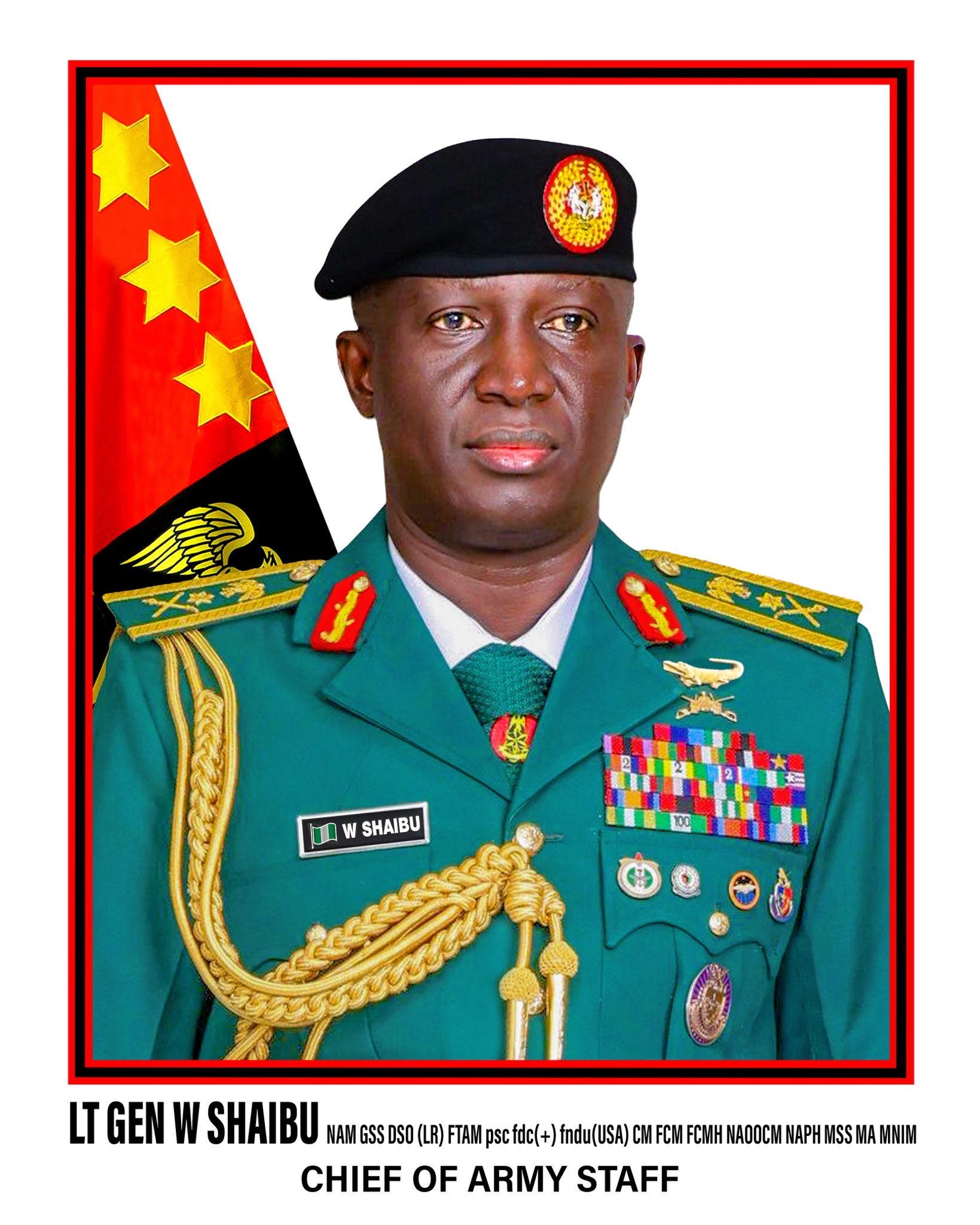
The Chief of Army Staff, Lieutenant General Waidi Shaibu, has directed soldiers from the Joint Task Force North Central, also known as Operation Savannah Shield, to step up operations against criminals terrorizing communities in the region.

Speaking during his inaugural operational tour at Sobi Barracks in Ilorin, the army chief emphasized the need for heightened action to eliminate threats such as kidnappers and bandits operating across the joint area of responsibility.

General Shaibu reiterated the Nigerian Army’s unwavering dedication to its constitutional duty to protect lives and property, stating that troops have maintained steady pressure to prevent criminal elements from running rampant or endangering national security.

He assured service members that additional combat resources and support equipment are being provided to strengthen ongoing missions aimed at clearing criminal hideouts in both Kwara and Niger states.

The army chief also stressed the importance of troop welfare, promising continued improvements to keep morale high and ensure operational effectiveness. He urged soldiers to remain disciplined, professional, and loyal to the constitution and the democratically elected government.

Posted on Leave a comment

NAHCON Mandates Refunds for Nigerian Pilgrims After Substandard Meals Rejected in Saudi Arabia

NAHCON Mandates Refunds for Nigerian Pilgrims After Substandard Meals Rejected in Saudi Arabia

The National Hajj Commission of Nigeria (NAHCON) has announced that refunds will be issued to pilgrims impacted by a food service failure during the ongoing 2026 Hajj in Saudi Arabia. This decision follows the rejection of certain meals provided to Nigerian pilgrims, which did not comply with approved health and packaging standards set by Saudi authorities.

In an official statement, NAHCON emphasized its dedication to the safety and well-being of all Nigerian pilgrims. The commission noted that Saudi health regulations are strictly enforced during the pilgrimage, particularly given the current climatic conditions in the Kingdom.

According to the statement, dinner meals served on the evening of May 27, 2026, were found to be substandard in handling and packaging. In coordination with Saudi officials, these meals were promptly refused. To alleviate inconvenience, the service support company distributed alternative light refreshments to affected pilgrims. Meanwhile, NAHCON board members visited state officials and managers to provide updates.

Chairman Ambassador Ismail Abba Yusuf has directed the commission’s security committee to investigate the caterers responsible for the incident, as well as any individuals involved in procuring the contracts. Additionally, a separate inquiry has been ordered into tour operators suspected of exceeding registered pilgrim numbers and exploiting unsuspecting participants during the Hajj.

NAHCON has warned that any operator found guilty of misconduct will face severe penalties, including potential revocation of operating licenses. The commission has already initiated arrangements for immediate refunds to affected pilgrims.

Expressing gratitude for the pilgrims’ patience, NAHCON reassured them that their welfare remains a top priority throughout the Hajj exercise. “NAHCON appreciates the understanding of the pilgrims and reassures all of its continued commitment to their welfare throughout the Hajj exercise,” the statement read.