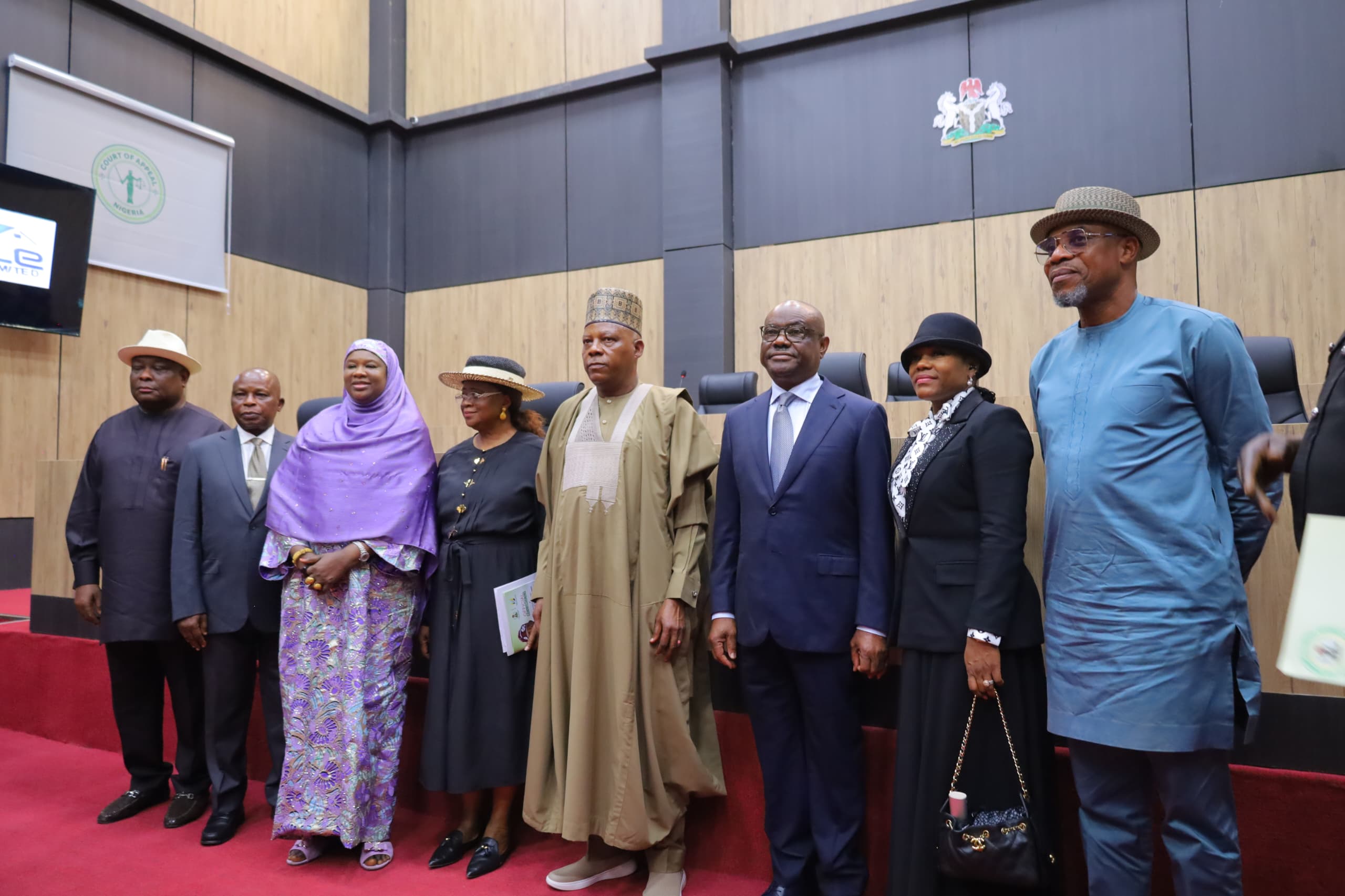
President Bola Ahmed Tinubu has underscored his government’s dedication to bolstering Nigeria’s judiciary, insisting that the rule of law must be housed in infrastructure that befits its importance. Speaking through Vice President Kashim Shettima at the inauguration of the Court of Appeal Abuja Division Building Complex in Dakibiyu, Tinubu outlined that modern facilities, enhanced welfare, and systemic reforms are essential to deepen democracy and broaden access to justice.
The newly commissioned complex, a centerpiece of the Renewed Hope Agenda, features two expansive courtrooms, eight smaller ones, a library, ten judges’ suites, three conference halls, and administrative offices with supporting amenities. Tinubu described the project as a powerful symbol that the current administration is serious about restoring the dignity of democratic institutions.
Referring to the previous cramped conditions under which the Abuja Division operated, the President remarked that it was unacceptable for an institution charged with delivering justice. He noted that a nation seeking justice must honor its temples of justice, and he gave a direct order to rectify the situation. Today, that order has been fulfilled.
Tinubu lauded FCT Minister Nyesom Wike for executing the project swiftly, calling him “Mr. Project.” He recalled that Wike promised completion in 16 months and delivered ahead of schedule without excuses or cost overruns. The President asserted that this achievement demonstrates what Nigerians can expect when commitment meets action.
The complex, according to Tinubu, will expedite judicial processes, alleviate overcrowding in correctional centers, and strengthen democratic governance. He emphasized that honoring the judiciary in this manner reinforces democracy itself. The project aligns with broader judicial reforms, increased funding for the judiciary, and a push for a just, rule-based society.
Tinubu also commended the FCT Administration for constructing additional courts, building residences for judicial officers, digitizing court procedures, and supporting legal education. He acknowledged the heavy workload of the Court of Appeal, especially in election petitions and constitutional matters, assuring that judges deserve an environment that matches the gravity of their responsibilities.
The President praised Visible Construction Limited for showcasing the capability of local firms to deliver world-class infrastructure. He urged judges to ensure justice remains swift, impartial, and indifferent to status, ethnicity, or wealth, so that the common person truly sees the court as a last hope.
Attorney-General of the Federation and Minister of Justice, Prince Lateef Fagbemi (SAN), described the commissioning as a historic milestone coinciding with the Court of Appeal’s 50th anniversary. He stated that the event signals the administration’s unwavering commitment to the rule of law and judicial independence. Fagbemi highlighted that no previous administration has provided such extensive support to the judiciary, citing a historic 300% increase in judicial officers’ remuneration—the first major upward review in decades.
Beyond salary reforms, Fagbemi noted an ambitious infrastructure program, including residences for justices and judges across various courts. He also pointed to the appointment and confirmation of qualified judicial officers, ensuring the Supreme Court reached its full constitutional complement, which has enhanced its capacity and reduced delays.
FCT Minister Nyesom Wike explained that the project originated from concerns about the poor state of the Abuja Division. After informing the President, he was directed to provide both a befitting complex and decent housing for judges. Wike announced that residences for Court of Appeal judges would be handed over the next day, followed by those for Federal High Court judges and FCT High Court judges. He also revealed plans to flag off housing projects for the Industrial Court and Code of Conduct Tribunal. Wike argued that judicial independence cannot exist without proper facilities and urged residents to fulfill their civic duties, such as paying ground rents and tenement rates, to fund development.
President of the Court of Appeal, Justice Monica Dongban-Mensem, called the complex a transformative intervention. She noted that the Abuja Division had long managed with only two courtrooms and limited administrative space despite handling a heavy caseload. The lack of infrastructure had forced the court to rely on accommodations from sister courts, which sometimes suspended their own sittings. With the new complex, she said, those burdens are lifted.
The event, part of the Tinubu administration’s third anniversary and the Court of Appeal’s golden jubilee, was hailed as a reaffirmation of the government’s dedication to judicial reform and improved access to justice. The Minister of State for FCT also thanked the President, Wike, and all stakeholders for their support, while the Managing Director of Visible Construction Limited, Olalekan Adebiyi, emphasized the project’s demonstration of indigenous capacity in infrastructure delivery.